

Seitenbereiche:
Hauptmenü:
dunkelblauer streifen
Bereichsname:
> > > > > >
Topics in English
Top menü
Standard Version | Sitemap | Kontakt | Hilfe | ein Druckersymbol
 Erweiterte Suche
Welcome 
to Lower Austria 
blue sky and the building of government

Waldviertel

Waldviertel

The name Waldviertel (forest district), deriving from the extensive forest cover of this region in the north-west of Niederösterreich, paints a realistic picture of this rough, yet totally idyllic landscape. The Waldviertel is not just rich in castles and monasteries, it also boasts a host of mystical places which form the basis for a wealth of sagas and fairytales.


rocking stones

A typical feature of the Waldviertel are the many high moor land areas and the so-called Wackelsteine (rocking stones), granite rocks weighing several tonnes which are poised so precariously that a touch in a certain place could set them in motion.

Agriculture and forestry still play a key role in the Waldviertel. However, health tourism is developing into an increasingly important extra string to the region's economic bow. Countless spas, moor land baths and centres geared up to treat heart/circulatory problems and dispense general fitness invite visitors to enjoy relaxation and regeneration.


cycle track in the Waldviertel

The idyllic landscape and the well-developed tourism infrastructure are ideally suited to extended walks and cycle tours, as well as cross-country skiing in winter. Many of the well-marked tours and routes also lead into neighbouring Bohemia and Moravia - a successful example of functioning cross-border co-operation across the former Iron Curtain.

In recent years, a large number of extensive and scenically delightful golf courses have opened in the Waldviertel, contributing to make the region a Mecca of this sport.


But it is not just those seeking relaxation or activity holidays who will find exactly what they are looking for; culture lovers, too, will be delighted. Towns such as ZWETTL and WEITRA or the famous Baroque convent of Geras with their secular and religious buildings of historical and cultural importance, are all evidence of the rich history of the Waldviertel.

Municipality of Zwettl

Niederösterreich in general, but the Waldviertel in particular, can boast a centuries-old beer brewing tradition of importance well beyond this region and it is home to some of the best breweries in the whole country.

The valley of the River Kamp offers delightful scenery. In its upper reaches the river flows west to east while below the mighty Rosenburg which is home to a museum of freemasonry the Kamp turns southwards. Along the 30-kilometre or so long section from Horn to Langenlois, a traditional summer holiday area, there are many bathing places and turn-of-the-19th century villas.

This area has made a name for itself thanks to tourism angled at health and well-being, centred around Gars, where Willi Dungl's health centre has treated many famous international sports champions including the former Austrian Formula-1 driver Niki Lauda and the German top tennis player Steffi Graf.

Rosenburg
Langenlois
Gars am Kamp


wine-growing in the Wachau

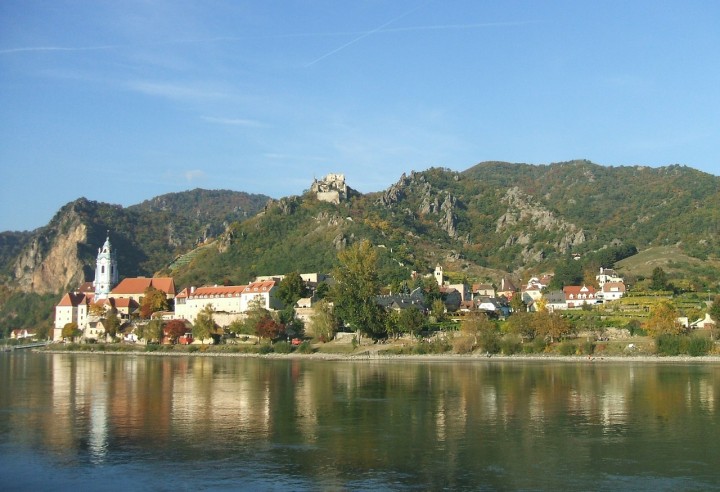
The river Danube forms the southern arm of the Waldviertel, with the scenically delightful section of the Danube valley from the border with Upper Austria to Melk being named the "Nibelungengau". The adjacent 30-kilometre stretch from Melk to Krems is called Wachau and its beauty has earned it the name 'the pearl of the Danube valley'.

The Wachau area is one of Austria's most popular tourism destinations and has recently been designated as a UNESCO world heritage site. There are many reasons to justify this: comprising the beauty of this deeply carved river valley, the excellent white wine which is produced from the labour-intensive terraced vineyards in this area, the bewitching blossoming of thousands of apricot trees in the spring and the area's wealth of cultural treasures.

Tourism Wachau-Nibelungengau

Online guide Wachau surroundings


Melk Monastery

Starting from Melk with its world-famous baroque church, built by the famous architect Jakob Prandtauer, whose library was an inspiration for Umberto Eco's best-seller 'The Name of the Rose', the visitor has the choice of travelling by ship, bicycle, train or car down the Danube past the vineyards and the many points of interest in this narrow defile of the Danube.

Melk Monastery

Alongside Spitz and Weißenkirchen, the classic examples of wine-growing villages, the idyllic ruins of Dürnstein rear up shortly before Krems. This eminence is where the English king Richard the Lionheart was held captive when returning home from a Crusade to the Holy Land.

Opposite, on the right-hand bank of the Danube the attractions include the Benedictine monastery of Göttweig, a baroque complex with a view down into the Danube valley, built according to plans by Lukas von Hildebrandt.

The Wachau area ends down the Danube at Krems which is therefore known as the 'Gateway to the Wachau'. This town is recognised as the cultural centre of Niederösterreich.


Krems in the night

Krems, a  University city with several interesting museums, can boast a thousand years of history and has a beautifully preserved old city centre with many Gothic and baroque churches.

Town of Krems


"Heuriger" in this region

A typical feature of this wine-growing region are the many 'Heurigen', taverns which serve wine from the latest harvest to accompany simple food. They are identified by having a pine branch exposed above the door.

Austrian Wine


WEITERFÜHRENDE INFORMATIONEN
Ihre Kontaktstelle des Landes NÖ

Verbindungsbüro

Mag. Ilse Penders-Stadlmann E-Mail: post.noevbb@noel.gv.at
Tel: 0032 2 549 06 60, Fax: 0032 2 502 60 09

1000 Brüssel, Rue du Commerce 20-22/ 6th floor

Lageplan, Adressen aller Dienststellen

Footer


Letzte Änderung dieser Seite: 15.09.2008